
Strengthening Safety & Security for Healthcare Professionals
A recent violent incident in our community where an individual attacked staff inside a healthcare office serves as a stark reminder: healthcare professionals face real safety risks every day. In environments where people are vulnerable, stressed, or in crisis, managers must be proactive in protecting both staff and patients.
While law enforcement response is critical in emergencies, electronic security systems can play a major role in preventing, detecting, and responding to threats before they escalate.
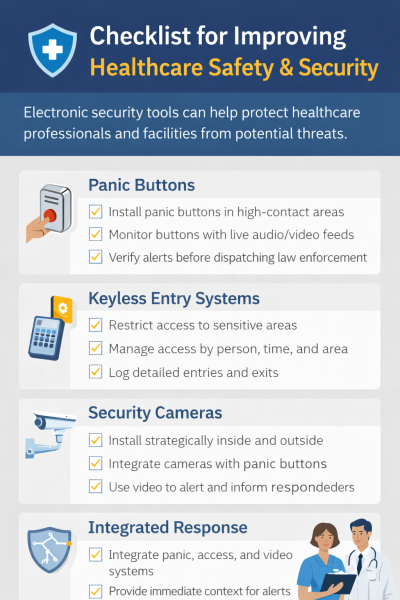
1. Panic Buttons & Verified Monitoring: Immediate Alerts When It Matters Most
One of the most effective tools for staff safety is a panic button system.
📍 Why panic buttons matter
Give staff a direct way to signal for help during an emergency situation
Can be placed at reception desks, nurses’ stations, exam rooms, and other high-contact areas
Reduce the time it takes for security personnel or first responders to intervene
⚠️ Verified panic systems take this a step further: when a button is activated, alerts are sent in real time to trained monitoring operators who can assess the situation and dispatch law enforcement immediately, often with live audio or video feeds. This ensures that even if staff cannot speak or call out for help, assistance is on the way.
This level of verification and monitoring can be lifesaving in high-stress moments.
2. Keyless Entry Systems: Control Who Has Access and When
Controlling movement within a healthcare facility is essential — both for patient privacy and staff safety.
🔐 Advantages of keyless entry systems
No lost or stolen keys to manage
Ability to restrict access to sensitive areas (e.g., records rooms, medication storage, administrative offices)
Set schedules for who can enter specific areas and when
Detailed logs of who accessed what and when
For example, front-desk staff or clinical teams can have different access rights than maintenance crews — and access can be tightened or revoked instantly if concerns arise.
This helps reduce unauthorized access that may lead to confrontations or compromised safety.
3. Security Cameras: Eyes on Every Corner
Cameras aren’t just for deterrence — they’re a vital part of awareness and evidence.
🎥 Strategic camera placement
Main entry and exit points
Waiting areas and reception desks
Corridors leading to exam rooms
Parking lots and patient drop-off zones
Modern systems can be integrated with access control and panic alert systems. If a panic button is triggered, cameras in that zone can automatically begin recording at higher frame rates or send clips to security teams and law enforcement in real time.
This not only deters dangerous behavior but also helps investigators understand what occurred and how to improve future safety protocols.
4. Integrating Systems for a Comprehensive Security Strategy
When panic buttons, access control, and video surveillance work together, the result is a layered safety protection system:
✔ Quick alerting
✔ Controlled access
✔ Immediate visual context
✔ Faster coordinated responses
This integrated setup can also support staff training and post-incident reviews, giving administrators data to improve policies and physical layouts.
Protecting People — Not Just Property
Healthcare facilities are places of healing, not harm — but workplace violence is an unfortunate reality that can affect even the most caring environments. Using modern electronic security tools helps managers take control of safety risks, protect staff, and maintain a secure, welcoming atmosphere for patients and visitors.
Safety is not just about reacting after an incident — it’s about preparing and preventing whenever possible.